Where SOC Investigation Capacity Actually Breaks in 2026
Vendor breaches, sovereignty rules, and analyst burnout are hitting Southeast Asian SOCs from three directions in 2026. All three trace back to the same number: per-alert investigation time.
- Vendor breaches like Instructure's approximately 280 million-record incident are forcing SOCs to scope investigation blast radius across hundreds of correlated alerts.
- Third-party involvement in breaches doubled year over year, from 15% to 30% (Verizon 2026 DBIR).
- The average SOC investigates only 37% of daily alerts; investigation capacity, not tooling, is the binding constraint.
- SQUDO AI has no single default residency: it can be deployed on-premises, on the customer's own infrastructure, or within a sovereign region the customer selects at provisioning (Singapore, Malaysia, Indonesia, or Switzerland), per the Trust Center's residency policy.
- In benchmarks, SQUDO AI reduces per-alert investigation time from approximately 40 minutes to 4-10 minutes.
Security teams in Singapore and Malaysia are running into the same wall from three different directions this year. A vendor breach forces investigation work that outpaces available analyst hours. Regional data sovereignty rules are starting to treat AI-driven alert analysis as a cross-border data transfer rather than a simple hosting decision. And the industry's default fix for analyst burnout, hiring more Tier-1 staff, is running into a global talent gap of roughly 4.7 million unfilled cybersecurity roles (ISC2 Workforce Study). All three problems trace back to the same number: how long it takes to fully investigate a single alert.
| Fracture point | What's breaking | Why it matters |
|---|---|---|
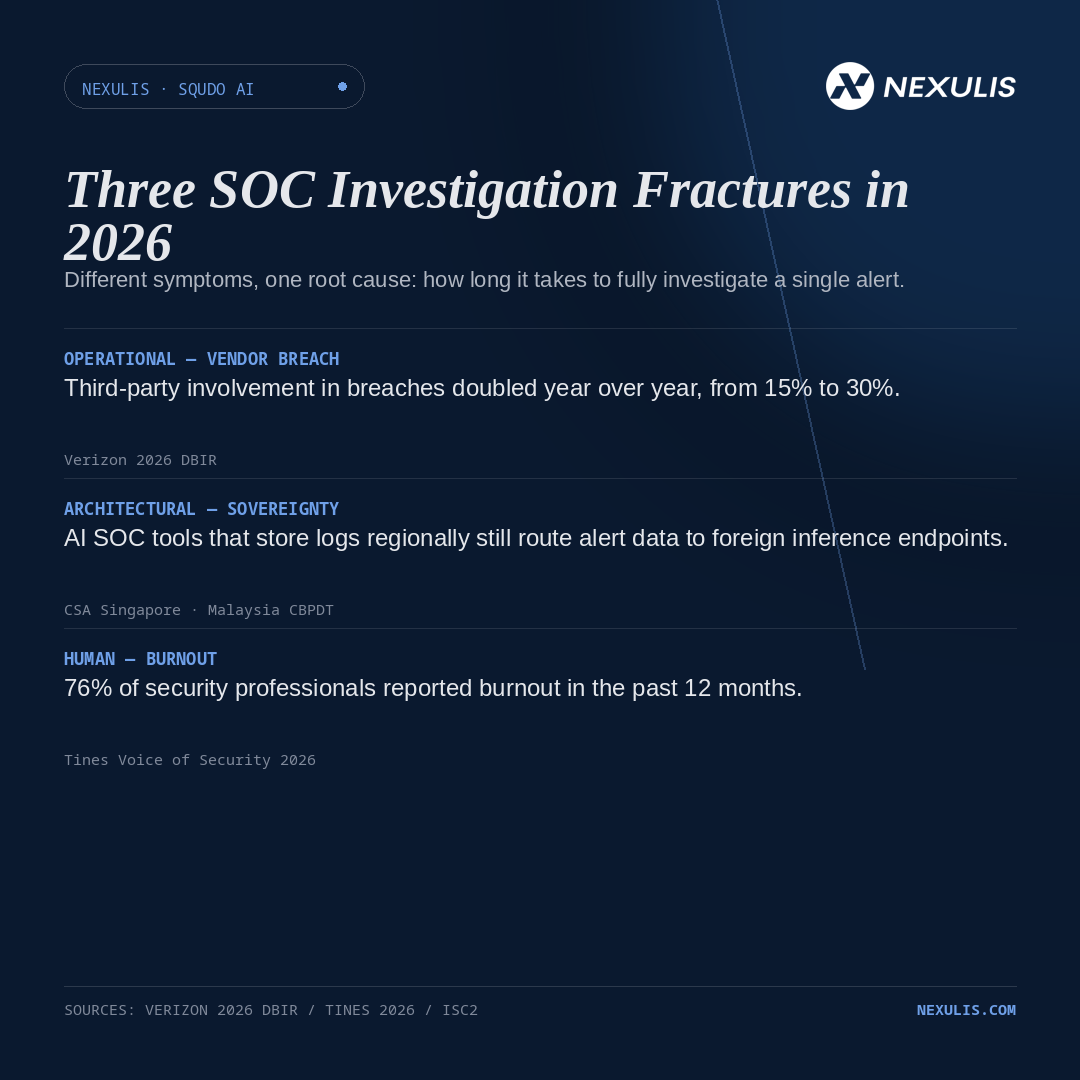
| Operational (vendor breach) | Blast-radius scoping after a third-party compromise exceeds manual investigation capacity | Third-party involvement in breaches doubled year over year, from 15% to 30% (Verizon 2026 DBIR) |
| Architectural (sovereignty) | AI SOC tools that store logs regionally still route alert payloads to a foreign inference endpoint | Singapore's Cyber Trust Mark and Malaysia's Cross-Border Data Transfer Guidelines both tighten through 2026-2027 |
| Human (burnout) | Hiring more Tier-1 analysts no longer scales against the workload | 76% of security professionals reported burnout in the past year (Tines, 2026); the global talent gap sits near 4.7 million roles (ISC2) |
A vendor breach nobody could patch their way out of
On 30 April 2026, attackers compromised Instructure, the parent company of the Canvas learning management system, through a vulnerability tied to API keys. Instructure disclosed the breach on 1 May and confirmed data exposure on 4 May. ShinyHunters claimed responsibility on 3 May, asserting it had stolen approximately 280 million records covering students, teachers, and staff across 8,809 institutions, including names, emails, and student ID numbers. Passwords and financial data were not involved.
It wasn't an isolated event. Verizon's 2026 Data Breach Investigations Report, covering incidents from November 2024 through October 2025, found that third-party involvement in breaches doubled year over year, from 15% to 30%, driven by software supply chain compromises, weak vendor security practices, credential exposures, and misconfigured SaaS environments.
The pattern has repeated three times in twelve months. The Salesloft-Drift OAuth campaign in August 2025 hit more than 700 organizations, including Cloudflare, Palo Alto Networks, and Zscaler, by compromising OAuth tokens. The Gainsight breach that November compromised more than 200 additional Salesforce tenants the same way, and the Vercel/Context.ai incident in early 2026 showed the identical pattern reaching into AI-tooling stacks. Instructure is simply the education-sector instance of a template that keeps recurring.
The AI SOC investigation time benchmark hiding inside blast-radius math
When a vendor higher up the supply chain gets breached, the question a CISO actually faces isn't "are we patched." Patching doesn't matter when the compromise runs through an authentic OAuth grant or a legitimately issued API key. The real question is how long the SOC needs to determine which identities, tokens, sessions, and data flows sit inside the blast radius. Industry guidance on third-party incident response points to 3 to 6 months of historical log retention as the minimum needed to scope a vendor compromise, since analysts have to reconstruct when access was first established and what was touched in the meantime.
For most regional SOC teams, that scoping work takes days right now. The industry-wide benchmark for per-alert investigation time runs around 40 minutes of hands-on analyst work, and a vendor blast-radius exercise typically involves dozens to hundreds of correlated investigations across SIEM, identity, EDR, and SaaS audit logs. Run the arithmetic and the math stops being forgiving fast.
Tightening the contracts doesn't fix this: Instructure's breach hit 8,809 institutions whose contracts presumably required reasonable security controls already. Better detection tooling doesn't fully fix it either, not when the credential is legitimately issued and the OAuth grant is authentic, as in Salesloft-Drift. Behavioral detection has very limited signal in that scenario; the compromise looks like normal vendor activity right up until lateral movement starts.
Sovereignty is a data-flow problem, not a hosting checkbox
In April 2026, The Edge Singapore published an analysis arguing that Asia's cloud has become a sovereign asset but is still secured "like a tech product." Governments, regulators, and financial institutions across Southeast Asia now depend on cloud infrastructure for functions that used to sit on sovereign-controlled systems, and the security tooling layered on top hasn't kept pace.
The threat reality behind that argument is documented, not theoretical. On 18 July 2025, Singapore's Coordinating Minister for National Security disclosed that the country had been targeted by UNC3886, a state-sponsored APT group tied to Chinese espionage operations, hitting four telco operators (M1, StarHub, Singtel, Simba) through zero-days in Fortinet, VMware, and Juniper systems. Operation CYBER GUARDIAN, Singapore's largest coordinated cyber incident response to date, ran for more than 11 months; containment was confirmed on 9 February 2026, with a small number of critical systems breached but no services disrupted and no customer data confirmed stolen.
Singapore's regulatory response has been structural rather than tactical. The Cyber Security Agency has expanded Cyber Trust Mark requirements across Critical Information Infrastructure owners, CII auditors, and licensed cybersecurity service providers, with deadlines landing between end-2026 and end-2027. Cybersecurity Act amendments confirm CII owners stay responsible for cybersecurity even after functions move to cloud: migration doesn't transfer the legal obligation.
Malaysia has moved on a parallel track: the Personal Data Protection (Amendment) Act rolled out in phases through 2025, and its Cross-Border Personal Data Transfer Guidelines replaced the old whitelist approach with a risk-based framework requiring a Transfer Impact Assessment, with financial and telecommunications data required to stay physically inside Malaysia.
None of this is really about vendor trustworthiness. It's about jurisdiction. AI SOC tooling that stores customer logs in a Singapore-region bucket but ships alert payloads to a US-hosted analysis endpoint every time it examines an alert is, on a regulator's reading, transferring SOC data abroad on a routine basis. The counterargument is that inference data is operational metadata, not regulated personal data. That deserves a direct answer: PDPA-class regulators in both markets have moved toward broader interpretations covering any data that, combined, can identify a person or expose security posture, and alert payloads meet that threshold. The underlying driver, US jurisdiction under the CLOUD Act and FISA Section 702, applies regardless of where the data physically sits.
Why hiring more analysts doesn't fix any of this
Analyst burnout is well documented at this point. Tines' Voice of Security 2026 report, based on more than 1,800 global security professionals, found that 76% experienced burnout in the past 12 months. Heavy workload was the primary cause for 39% of respondents; repetitive tasks and incident-response stress tied for second at 26% each, and 81% said workloads had increased over the prior year.
The mechanism behind that number is fragmentation, not just volume. The average SOC receives around 4,400 alerts a day (Swimlane research, via D3 Security), investigates only 37% of them, and spends an average of 56 minutes gathering context before investigation even starts. Average analyst tenure sits under three years, and 61% of SOC teams admit to ignoring alerts that later turned out to be genuine.
The industry's default answer has been to hire more Tier-1 analysts. That answer is breaking down against a global cybersecurity talent gap of roughly 4.7 million unfilled roles (ISC2 Workforce Study), and regional hiring markets in Singapore and Malaysia are tighter still. Part of the problem is the job itself: investigation work has been broken into thousands of fragmented tasks, context-gathering across multiple consoles, cross-correlation against a scattered evidence base, and reporting that eats more time than the investigation does.
The more defensible position isn't that Tier-1 disappears. It's that Tier-1 gets redefined, and that only happens once investigation runs at a different layer of the stack. When an investigation engine handles evidence correlation, hypothesis testing, and initial triage, the Tier-1 role shifts toward judgment: deciding whether a verdict is sound, whether deeper inquiry is warranted, and how to tune the system's behavior for the organization's actual threat surface.
"There will never be an autonomous SOC." (Gartner)
Prophet Security frames the emerging role as "validating agent-led investigations, determining when deeper inquiry is needed, and guiding system behavior over time." Microsoft's Agentic SOC position paper, published in April 2026, argues investigations need to happen in minutes rather than hours, with the time saved reinvested in deeper investigation and systemic hardening. Gartner forecasts AI will automate roughly half of Tier-1 responsibilities by 2028, explicitly framed as augmentation rather than replacement.
None of this should be oversold. Vendors have promised Tier-1 transformation for two years, and most deployments so far are pilot-grade, not the redefinition being pitched. The honest distinction is between agentic investigation, which reasons through evidence dynamically, and SOAR-style playbook automation, which executes predefined scripts. The latter hasn't delivered on this promise; the former is only now reaching production maturity, and the proof points are still early. It's also fair to say some organizations will use AI SOC tooling as a headcount-reduction lever rather than an upskilling one. Both outcomes are real.
One constraint, three fractures, and where investigation actually needs to run
Line up the three problems and they resolve into the same root cause. The vendor-breach math breaks because per-alert investigation takes too long to scope a blast radius at the speed a board needs answers. The sovereignty problem breaks because most AI SOC tooling routes investigation data outside the customer's jurisdiction. The burnout problem breaks because the Tier-1 job, as structured today, asks analysts to do fragmented, low-judgment work at a volume no hiring plan can match. All three point at the same fix: investigation needs to run at a different layer of the stack, fast enough to matter, built on infrastructure that respects its jurisdiction, and structured to produce evidence a regulator or a board can actually read.
SQUDO AI®, the Agentic AI SOC Platform developed by ITNB AG and deployed in Southeast Asia through Nexulis, is built around that exact constraint. It runs on top of existing SIEM, EDR, identity, and cloud tools rather than replacing them, connecting to environments like Microsoft Sentinel and IBM QRadar. Instead of executing predefined playbooks the way a traditional SOAR does, it generates hypotheses, tests them against evidence, prunes the ones that don't hold up, and iterates, closer to how an experienced analyst works than to a fixed script.
On the investigation-time math from the Instructure scenario: in benchmarks, SQUDO AI reduces investigation time from approximately 40 minutes to 4-10 minutes. Applied to a vendor blast-radius exercise running dozens to hundreds of correlated investigations deep, that's the difference between answering a board within a working day and answering it a week later.
On the sovereignty question: SQUDO AI has no single default residency. It can be deployed on-premises, on the customer's own infrastructure, or within a sovereign region the customer selects at provisioning (Singapore, Malaysia, Indonesia, or Switzerland), per the Trust Center's residency policy: data is processed and stored in the region you choose, with no cross-region replication without explicit consent. That's not a checkbox layered on top; residency is a deployment-model choice built into the architecture from the start. Architectures that make this choice explicit remain the minority in a market where most AI SOC vendors still route inference through wherever their analysis service happens to run.
On the burnout and redefinition question: every investigation SQUDO AI runs produces a structured, audit-ready report, a timeline, the hypothesis evolution, a verdict with a confidence level, MITRE ATT&CK mapping, and a full evidence log, the kind of output a board or regulator can read after a vendor incident. That's close to the shift Prophet Security and Microsoft describe: the analyst's job moves from context-gathering toward validating a documented verdict. Human-in-the-loop is a design principle here, not a caveat. Analysts review and validate; the system recommends, it doesn't execute containment unilaterally.
None of that closes the talent gap by itself, and it shouldn't be sold as though it does. But it changes what the Tier-1 job actually asks people to do, and it answers the vendor-breach and sovereignty questions at the same time, because all three were never separate problems to begin with. See how SQUDO AI approaches investigation time, sovereignty, and audit-ready reporting on the SQUDO AI product page.