Singapore's CCoP Board Accountability Mandate: What a Board-Ready Investigation Record Requires
Singapore's updated Cybersecurity Code of Practice will hold boards directly accountable for cyber recovery. Most SOCs can't yet produce the investigation record that accountability requires.
- Singapore's updated CCoP will hold boards and senior management directly accountable for "detect, respond, recover" — a higher bar than breach notification.
- CII owners will need a documented, annually reviewed cyber resilience framework and Cyber Trust Mark Level 5 certification.
- UNC3886's 11-month dwell time was a baseline problem: living-off-the-land techniques blend into normal activity without an established behavioral baseline.
- A board-ready investigation record needs four elements: a timeline built during the investigation, a verdict with confidence level, hypothesis evolution, and MITRE ATT&CK mapping.
On 22 and 23 July 2026, Singapore's Minister for Digital Development and Information Josephine Teo announced at the OTCEP Forum that the Cybersecurity Code of Practice for Critical Information Infrastructure will be updated to hold boards and senior management directly accountable for cyber resilience, specifically the "detect, respond, recover" mandate. That's a distinct, higher bar than breach notification, and it's the center of Singapore CCoP board accountability cyber resilience planning for CII owners this year. Boards will need a documented cyber resilience framework covering risk tolerance, mitigation, transfer, and recovery, reviewed at least annually, and CII owners will need Cyber Trust Mark Level 5 certification. Most SOC teams cannot yet produce the kind of investigation record a board would need to demonstrate that accountability is real rather than aspirational.
Boards are now liable for cyber recovery, not just notification
The mandate is a direct response to UNC3886, the state-sponsored campaign that hit Singapore's telecommunications sector. Containing it took Operation Cyber Guardian: 11 months, more than 100 specialists, and six agencies, CSIT, the SAF Digital Intelligence Service, the Internal Security Department, GovTech, CSA, and IMDA. The operation closed the gap between "notify regulators when breached" and "demonstrate to regulators that your board owned the recovery plan before the breach happened." Minister Teo framed the new mandate as a direct response to AI-driven and state-sponsored threats that now target critical infrastructure at the board governance level, not just the technical one.
Singapore isn't alone in this direction. The EU's NIS2 directive introduces personal director liability, fines, and potential disqualification, with an October 2026 deadline; SEC, DORA, HIPAA, and CMMC are each moving toward some form of board-level personal liability in their own domains. PwC Singapore published dedicated guidance on navigating the new CII board requirements almost immediately after the announcement, which is a reasonable signal that boards are already asking how to comply rather than waiting to be told.
The strongest pushback here is a real one: boards are oversight bodies, not operators, and asking them to "own" a documented cyber resilience framework risks blurring the line between governance and management, muddying who's actually accountable for what a CISO does day to day. That concern deserves a direct answer rather than a dismissal. The mandate asks boards to define risk tolerance in writing, not to run the SOC. That's a governance act, not an operational one, and it's structurally different from simply reviewing a CISO's report after the fact. An audit committee overseeing a report is reactive. A documented, annually reviewed resilience framework is pre-incident.
Why an 11-month intrusion was a baseline problem, not a tool problem
UNC3886 didn't rely on custom malware that antivirus signatures could catch. It used living-off-the-land techniques: SSH credential harvesting, command-and-control traffic hidden inside Google Drive and GitHub, both routinely whitelisted services, and zero-days in Fortinet FortiOS, VMware vCenter and ESXi, and Juniper Junos OS. Named malware families, MOPSLED, RIFLESPINE, REPTILE, and TINYSHELL, weren't deployed until after the living-off-the-land phase had already established persistence. Detection came on 18 July 2025; dwell time before that is reported, in secondary coverage, as running from months to years, with attackers reportedly prioritizing stealth through passive backdoors and log tampering.
The mechanism matters more than the timeline. EDR tools generally struggle against living-off-the-land techniques because, without event correlation capabilities, it's hard to tell whether an individual step is malicious at the system level when every action uses an expected tool performing a plausible task. Behavioral analytics, UEBA, can distinguish legitimate from malicious use of the same legitimate tools, but only against an established baseline of what normal looks like.
UNC3886 "highlighted the limits of signature-based detection and the need for behavioural baselines tied to network-normal activity patterns." (Black Panda)
The broader trend points the same direction: adversaries increasingly rely on abuse of trust, valid credentials and legitimate administrative capabilities, rather than software exploitation, building execution paths that blend into normal enterprise operations.
The obvious pushback is that eleven months is a detection failure and better EDR or properly tuned UEBA would have caught it sooner. That's only true if a baseline existed to tune against. The real question isn't whether behavioral tools can spot the anomaly once a baseline exists. It's whether organizations maintain documented normal-state baselines as an ongoing operational practice in the first place, rather than trying to reconstruct one after the incident is already underway.
What a board-ready investigation record actually requires
The CCoP mandate turns "detect, respond, recover" from a capability statement into a documentation obligation. Boards and regulators are moving to scrutinize detection timelines, internal breach conclusions, supporting evidence, and notification timing, not just the eventual outcome. Most SOC teams produce incident summaries. Very few produce investigation records with the depth this kind of scrutiny requires: a documented timeline built during the investigation rather than reconstructed afterward, and reasoning an outside party can actually follow.
Industry readiness assessments consistently find that a meaningful share of organizations lack a documented incident response plan or have never tested the one they have, though the precise figures vary enough across studies that no single percentage should be treated as an industry standard. What's more consistent is the qualitative pattern: most security teams report activity, not risk, when a board conversation calls for narrative, metrics, and evidence together. Detection speed, dwell time, and containment performance are increasingly being treated as governance indicators in their own right, not just operational KPIs buried in a quarterly deck.
There's a genuine trade-off worth naming honestly rather than glossing over. Documentation discipline during an active incident competes directly with response speed; typing case notes and maintaining an evidence chain pulls analyst attention away from containment exactly when containment matters most. The organizations that actually solve this don't resolve the tension through more discipline. They remove it through automation, generating the record as a byproduct of the investigation itself rather than as a separate task competing for the same analyst-minute.
Four elements of a board-ready investigation record
A record built to survive board and regulator scrutiny needs four things, and most SOC tooling today produces one or two of them by default rather than all four.
| Element | What it requires |
|---|---|
| Investigation timeline | Built during the investigation, not reconstructed after the fact |
| Verdict with confidence level | Not a flat "found nothing," but a stated certainty and the basis for it |
| Hypothesis evolution | What was tested and ruled out, not only the final conclusion |
| MITRE ATT&CK mapping | Ties what happened to a recognized framework a regulator can independently check |
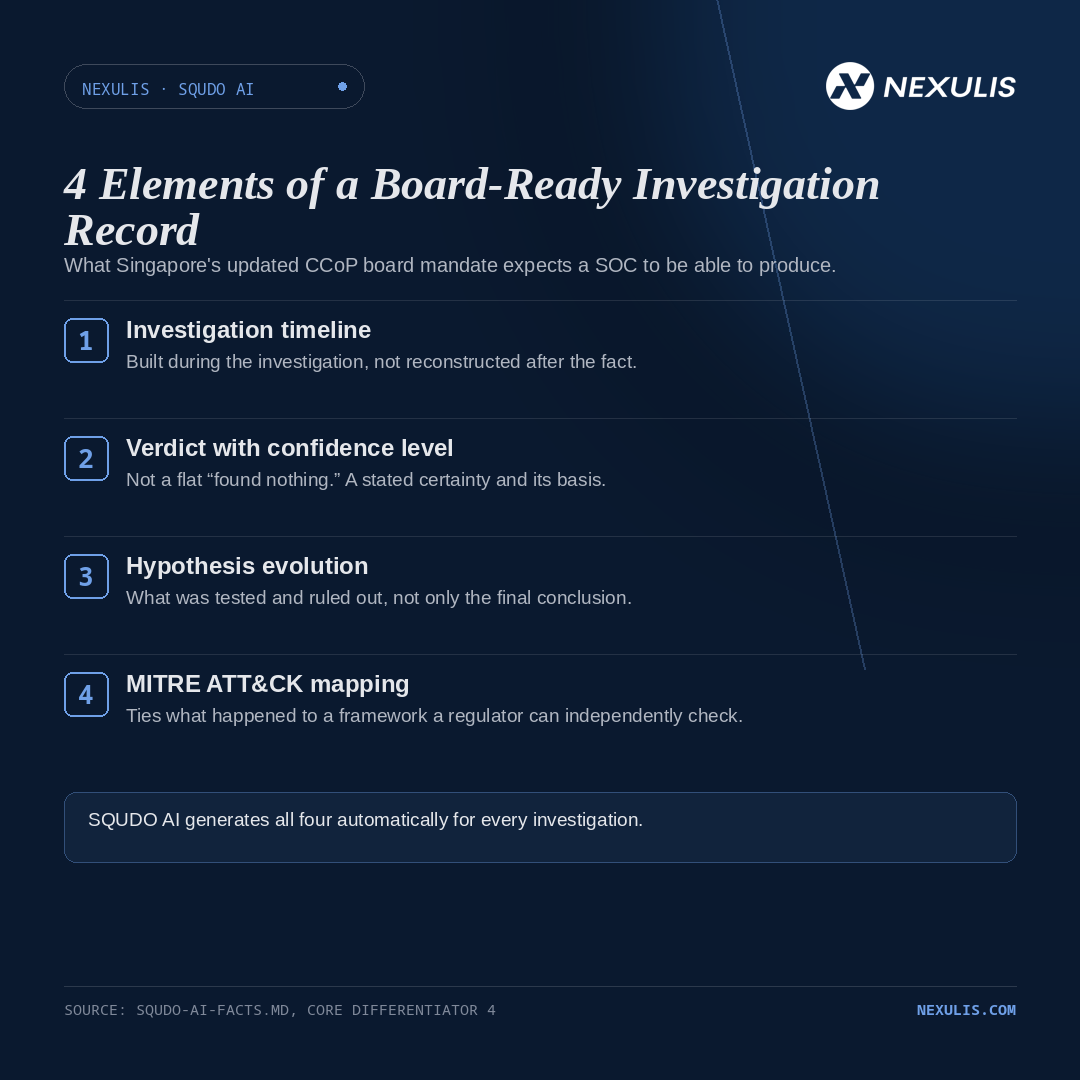
SQUDO AI®, the Agentic AI SOC Platform developed by ITNB AG and deployed in Southeast Asia through Nexulis, generates all four of these elements automatically for every investigation it runs: a timeline, a verdict with a confidence level, the hypothesis evolution, and MITRE ATT&CK mapping, alongside a full evidence log. That's a direct answer to the gap this piece has walked through, not a new argument bolted onto the end of one: most teams produce a subset of a board-ready record today, and the CCoP mandate is about to make the missing pieces a governance question rather than an internal one.
Worth keeping the four-element framing usable on its own, independent of any single vendor. Any SOC preparing for a board accountability conversation under the updated CCoP can use it as a checklist against whatever tooling and process it already runs. Save it, and check it against your last three incident write-ups. See how SQUDO AI generates board-ready investigation records on the SQUDO AI product page.