The Real SOC Alert Investigation Coverage Gap: Why 63% of Alerts Never Get Worked
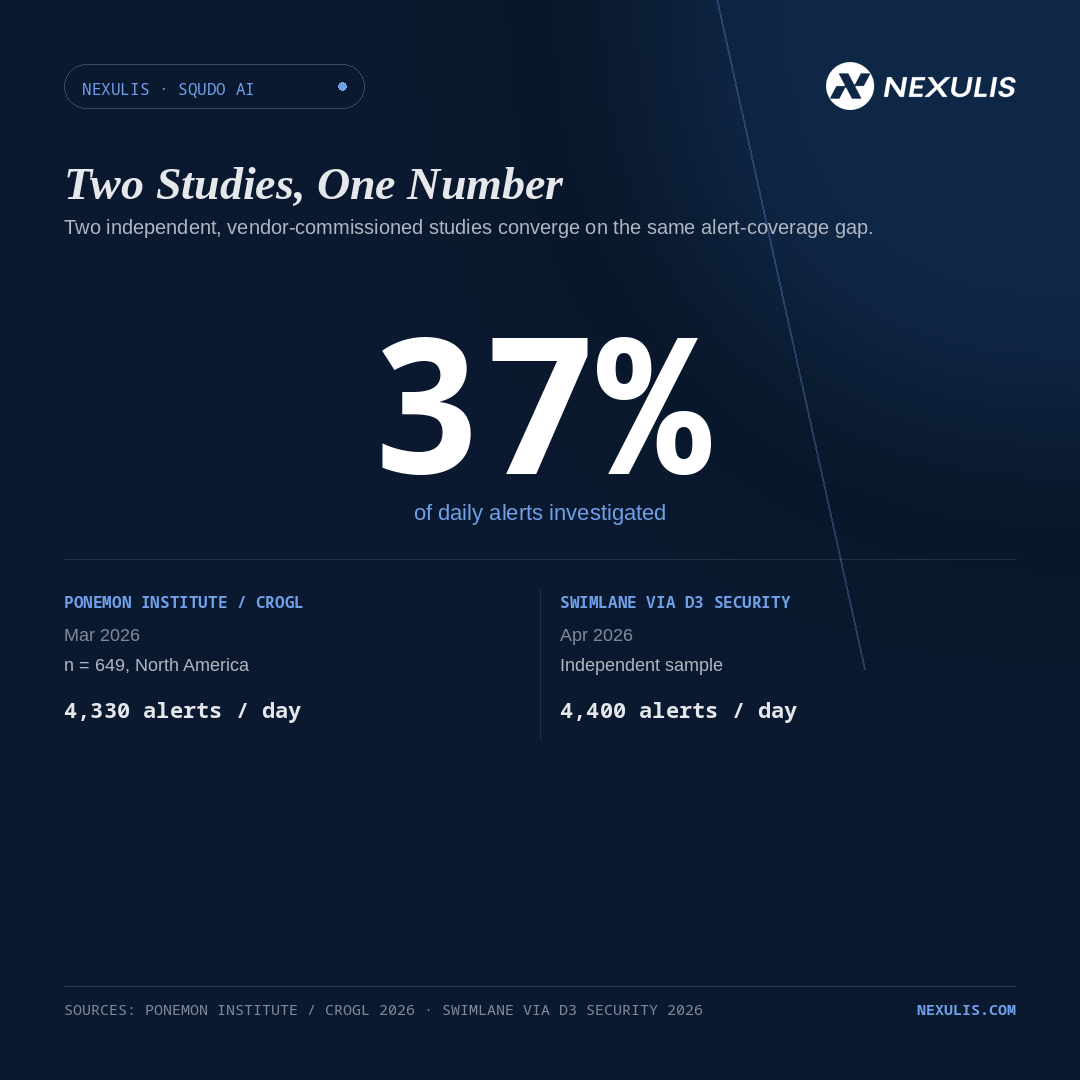
The average enterprise SOC investigates only 37% of the alerts it receives each day. Hiring more analysts can't close that gap; the arithmetic doesn't support it.
- Two independent 2026 studies (Ponemon/Crogl and Swimlane/D3 Security) both find SOCs investigate only 37% of roughly 4,300-4,400 daily alerts.
- Headcount can't close the gap: investigation capacity scales linearly with analyst-hours while alert volume scales with the attack surface.
- AI adoption is outpacing reported value: 71% of SOCs report little or no value from AI tooling so far, with workflow integration and dispersed data cited as the top barriers.
- The better standard is judging AI SOC tools on verdicts closed with an auditable evidence chain, not alerts filtered.
The average enterprise SOC investigates only 37% of the alerts it receives each day, according to two independent, vendor-commissioned studies that converge on the same figure. That's the real SOC alert investigation coverage gap, and the uninvestigated 63% isn't noise correctly dismissed at triage. It's alerts that cleared triage and were never worked, because investigation capacity ran out before the queue did. Hiring more analysts doesn't close that gap either; the arithmetic doesn't support it. The more useful fix is judging AI SOC tools on verdicts closed with an auditable evidence chain, not alerts filtered.
| Study | Sample | Alerts / day | % investigated |
|---|---|---|---|
| Ponemon Institute / Crogl, Mar 2026 | n=649, North America | 4,330 | 37% |
| Swimlane via D3 Security, Apr 2026 | Independent sample | 4,400 | 37% |
Triage isn't broken. Investigation is starved.
The consensus explanation for alert fatigue treats it as a filtering problem: too much noise coming in, so tune detections, tier severities, auto-close known-benign classes, and the queue becomes manageable. The 2026 data breaks that framing. The Ponemon Institute's State of SecOps study, commissioned by Crogl and published in March 2026 from 649 North American IT and security practitioners, found the average enterprise SOC receives 4,330 alerts a day and investigates only 37% of them. A separate, independently produced study reached the same coverage number: Swimlane research, cited via D3 Security in April 2026, put average volume at 4,400 alerts a day with 37% investigated. Two vendor-commissioned studies, different samples, the same convergent figure, worth attributing openly as vendor-commissioned rather than treating as neutral academic findings, since the convergence across independent samples is what makes the number defensible.
The same research found 61% of SOC teams admit to ignoring alerts that later proved genuine. Regionally, the pressure is rising rather than easing: infected infrastructure detected in Singapore rose 142% year over year to 284,300 systems in 2025, per CSA's Singapore Cyber Landscape 2025/2026.
"Your SOC is investigating less than half its alerts every day." (Tony Bradley, Forbes)
Detection engineers have a fair counter here: demand reduction upstream, fewer and better alerts, is cheaper than expanding investigation downstream, and mature tuning programs do genuinely shrink queues. That's worth conceding directly. The data doesn't say tuning is pointless. It says tuning alone hasn't been sufficient. The 63% figure is post-tuning reality, not a case for skipping the tuning work.
Why hiring your way out doesn't work
If the investigation layer is starved, the intuitive fix is headcount. The arithmetic doesn't support it. Human investigation capacity scales linearly at best, one analyst-hour per analyst per hour, while alert volume scales with the attack surface: endpoint, cloud, identity, network, SaaS. The gap between what a funded team can investigate and what the queue demands is structural, and it persists regardless of team quality.
Post-tiering volume that reaches human triage typically lands at 120 to 150 alerts a day even after tuning and suppression; at roughly 20 minutes per investigation including documentation, that's 40 to 50 analyst-hours of daily demand. The industry benchmark for per-alert investigation runs 20 to 40 minutes of hands-on work, and context-gathering alone averages 56 minutes before investigation even starts. The hiring fix is structurally unavailable even to well-funded teams: ISC2 estimates a global gap of 4.76 million unfilled cybersecurity roles, with demand growing 8.1% a year against workforce growth of just 0.1%. And the analysts already in seat are burning out. Tines' Voice of Security 2026 report, from more than 1,800 professionals, found 76% experienced burnout in the past 12 months and 81% reported workload increases.
Run a simple, illustrative worked example. A 4-person SOC covering standard shifts owns roughly 32 analyst-hours a day. At the 20-minute floor of the investigation benchmark, its theoretical ceiling is about 96 investigations a day, with zero time left for hunting, tuning, or reporting. Against a post-tiering demand of 120 to 150 investigable alerts a day, that's a gap of 25 to 55 investigations, every day, before annual leave, attrition, or an incident surge. The scenario is illustrative rather than a cited statistic, but the inputs feeding it (the benchmark minutes, the post-tiering volume, the analyst-hour math) are sourced, and the shape matches SEA reality, where mid-market Singapore and Malaysia SOC teams commonly run three to five analysts against thousands of endpoints.
Retention-focused leaders sometimes argue that expertise depth, not raw throughput, is the binding constraint. That's compatible with the arithmetic rather than opposed to it: capacity per analyst-hour is exactly what burnout erodes. Microsoft's Agentic SOC position paper, published in April 2026, argues investigations need to happen in minutes rather than hours, with the reclaimed time reinvested in deeper work and systemic hardening, not more triage.
The value gap in the first wave of SOC AI
AI adoption inside SOCs is running at record pace while reported value badly lags it. The SOC-CMM 2026 Maturity Report, surveying roughly 200 SOCs between late January and mid March 2026, found only about 10% say AI has delivered excellent value, 19% report good value, and the remaining 71% report some value or none. Adoption still grew across every category year over year: AI co-pilots up 145%, AI agents up 118%, off-the-shelf LLMs up 55%. 65% of SOCs are what the report calls "takers," dropping off-the-shelf AI into an existing stack, and takers report the least value of any group. The maturity scores explain why: technology maturity sits at 2.7 out of 5, process at 2.3, people at 2.3. The handoffs between stages, not the tools themselves, are the constraint, and effective governance is the single most-named improvement challenge, at 39%.
Ponemon and Crogl's 2026 research names the same layer as the sticking point: the top barriers to AI deployment are workflow integration, cited by 50% of respondents, and dispersed, hard-to-normalize data, cited by 49%. Both sit in the investigation layer, not triage, which is the layer the first wave of SOC AI mostly skipped. That first wave shipped as per-stage features, AI triage inside the SIEM, AI investigation inside the EDR, AI summaries inside ticketing, none of which share context across stages.
The cost of not investigating shows up concretely in Intezer's 2026 AI SOC Report: across a 25-million-alert dataset, roughly 1% of confirmed incidents originated as low-severity or informational alerts, which at a typical volume of about 450,000 alerts a year works out to roughly 54 real threats annually, close to one a week, never investigated under capacity-constrained models. That's Intezer's own extrapolation and should be attributed as such rather than stated as an industry fact. The same report scanned 82,000 endpoints forensically and found 2,600 with active infections, 51% of which had already been marked "mitigated" by the source EDR. A closed ticket is not a verdict.
"AI SOC marketing is better understood as prophetic rather than technical." (Anton Chuvakin, Google Cloud Office of the CISO, and Oliver Rochford)
Gartner's own forecast, that roughly half of Tier-1 SOC tasks will be AI-automated by 2028, is explicitly framed as augmentation rather than replacement, with Gartner stating flatly that "there will never be an autonomous SOC." That qualifier is doing real work and shouldn't get stripped out when the forecast gets cited.
Judge SOC AI on verdicts closed, not alerts filtered
The first wave of SOC AI was bought to filter alerts, and buyers are unimpressed: adoption is at record levels while 71% of SOCs report little or no value. The more useful standard is judging AI SOC tooling on investigations closed to a documented, auditable verdict, a metric that survives even if every vendor's marketing claims get discounted. This resolves what the first two sections established: the 63% coverage gap that headcount can't close is an investigation-capacity problem, and verdict throughput, not alerts filtered, is how to measure any proposed fix.
It's fair to call this "the second wave is the same marketing with a new label." That critique lands on every vendor in this category, including SQUDO AI. The answer isn't a request for trust; it's a falsifiable metric: verdicts closed per day, with an evidence chain an auditor can actually walk.
SQUDO AI®, an Agentic AI SOC Platform developed by ITNB AG and deployed in Southeast Asia through Nexulis, anchors on that standard directly. In benchmarks, SQUDO AI reduces per-alert investigation time from the roughly 40-minute industry average to 4-10 minutes, the one metric on its facts sheet that's benchmarked rather than projected. It runs agentic investigation rather than playbook automation: generating hypotheses, testing them against evidence, and asking follow-up questions when initial results are inconclusive, instead of executing a fixed script. And every investigation produces a structured, audit-ready report: a timeline, the hypothesis evolution, a verdict with a confidence level, MITRE ATT&CK mapping, and a full evidence log, the kind of record that answers "closed ticket or real verdict" with evidence rather than an assurance.
None of that resolves the market's broader value-and-governance problem, and it shouldn't be sold as though it does. The strongest counter-argument would come from teams where playbook automation is genuinely holding up at scale; if that describes a given SOC, that disagreement is worth hearing. What the verdict-throughput standard offers is a way to test any AI SOC claim, SQUDO AI included, against something other than a vendor's word. See how SQUDO AI approaches verdict-based investigation on the SQUDO AI product page.