Malaysia's Sovereign Cloud Moment: Why Your Security Stack Is the Part Nobody Is Securing
Malaysia committed RM2 billion to a sovereign cloud. A sovereign data center doesn't make operations sovereign if the security stack still ships evidence to a foreign AI endpoint.
- Malaysia's Budget 2026 allocated RM2 billion for a sovereign AI cloud, following PM Anwar Ibrahim's 2 July 2026 statement citing the US CLOUD Act as the driver.
- A sovereign data center purchase does not automatically make security operations sovereign: most AI SOC tooling still routes evidence to a foreign-hosted analysis endpoint.
- Sovereignty is better decided per workflow than per cloud purchase: the European Commission's own 48-criterion framework grades sovereignty in tiers, not as a single binary property.
- SQUDO AI has no single default residency: it can be deployed on-premises on the customer's own infrastructure, or within a sovereign region the customer selects at provisioning (Singapore, Malaysia, Indonesia, or Switzerland), per the Trust Center's residency policy.
- Malaysian data can stay in Malaysia under either the on-premises or the managed sovereign-SaaS deployment model; which applies is a deployment choice made at setup, not a fixed default.
On 2 July 2026, Prime Minister Anwar Ibrahim told the 39th Asia-Pacific Roundtable in Kuala Lumpur that Malaysia must build a sovereign cloud for critical security and personal data, backed by a RM2 billion allocation already tabled in Budget 2026. That's real money behind sovereign cloud Malaysia security operations planning, and it's the right instinct pointed at the wrong layer. A sovereign data center doesn't make an organization's operations sovereign if the security stack sitting on top of it still ships investigation evidence to a foreign-hosted AI analysis endpoint every time an alert fires. Sovereignty is a decision made per workflow, not a cloud purchased once, and the security operations center is usually the least examined piece of it.
A data center with a flag on it isn't sovereignty
Anwar's reasoning was explicitly legal, not technical:
"The Cloud Act has created some issues because President Trump has said that companies established in the United States have the right to penetrate and get all the data from countries where they invest." (Anwar Ibrahim)
He called a sovereign cloud "the ingenious way to protect our people and our interests," and in the same session conceded the limit: "in a globalised world, there are limits to such protection because, as a free, democratic country, we have some open access." That concession is the honest frame. Full-stack sovereignty is unaffordable and partially unachievable for most organizations; the defensible position is tiering, not absolutism.
Europe is roughly eighteen months ahead on exactly this failure mode. The term "sovereignty washing" entered mainstream trade coverage in March 2026 when CISPE, a body of 38 European cloud providers with an obvious commercial stake in the debate, warned the European Commission against letting hyperscalers hijack the definition. In April 2026, the Commission's own EUR 180 million sovereign-cloud award to a consortium including S3NS, a Thales-Google Cloud joint venture, triggered exactly that accusation. The EC then had to publish, on 1 June 2026, a 48-criterion scoring framework across four SEAL levels just to make "sovereign" a measurable word rather than a marketing one. Announcements don't define sovereignty. Scoring frameworks do, and even those get contested.
The CLOUD Act itself deserves more precision than it usually gets in this debate. Content disclosure requires a probable-cause warrant from a US judge, and providers can move to quash a request where it conflicts with foreign law. The exposure is jurisdictional, not a case of routine warrantless access, and overstating the mechanism undercuts an otherwise sound argument. The real point survives the nuance: a sovereign data center procured as a line item doesn't answer where analysis happens, who can be compelled to produce it, or what leaves the boundary during an investigation. That gap is nobody's line item right now.
Your security stack is your biggest data exporter
Sovereignty reviews tend to focus on primary data at rest: citizen records, financial data, health records. Meanwhile, security operations continuously exports the richest operational dataset an organization produces, endpoint process trees, authentication histories, network flows, alert payloads, investigation evidence, to wherever its tooling's analysis plane happens to live. Stamus Networks frames the destination of security telemetry as the sovereignty question almost nobody asks. The AI layer sharpens it further: as UnderDefense puts it, the model runs wherever the inference endpoint lives, regardless of where the SIEM stores data. If that endpoint is a US-hosted API, every log line it reads becomes a cross-border transfer, typically, not by law of nature, since hyperscalers increasingly offer regional AI processing too.
The legal mechanics here are frequently misstated in both directions. The CLOUD Act imposes two cumulative conditions: the provider has to be subject to US jurisdiction, and the data has to be in its possession, custody, or control. Where both hold, storage location is irrelevant, a Singapore or Kuala Lumpur data center owned by a US-incorporated provider is still within reach. Where they don't both hold, it isn't: a foreign parent's data outside a US subsidiary's control is not compellable through that subsidiary. Residency and sovereignty diverge exactly at that line. Malaysia's Cross-Border Personal Data Transfer Guidelines already impose this discipline on business data, requiring a Transfer Impact Assessment for cross-border transfers and mandating that financial and telecommunications data stay physically inside Malaysia. Singapore's Cybersecurity Act amendments run the same logic for infrastructure: critical information infrastructure owners retain legal responsibility for cybersecurity even when functions move to cloud. The discipline already exists for the data everyone thinks to classify. Security exhaust routinely escapes it.
It's fair to push back that telemetry is lower-sensitivity metadata, and treating all of it at business-data classification is expensive gold-plating. That's a reasonable concern and it depends on the data class. But process trees, authentication logs, and investigation evidence routinely contain personal data and incident detail, which is exactly the material a Transfer Impact Assessment is supposed to catch.
Sovereignty is a per-workflow decision, not a per-cloud decision
Infrastructure-first sovereign migrations invert the actual dependency. The European Commission needed 48 criteria and four SEAL levels to score providers precisely because "sovereign" isn't one property; no single infrastructure purchase delivers all of it. In the April 2026 award round, three consortia (Post Telecom with CleverCloud and OVHcloud, STACKIT, and Scaleway) reached SEAL-3, technological autonomy, while Proximus and S3NS reached only SEAL-2, data sovereignty. Even Europe's own procurement treats sovereignty as graded, not binary.
McKinsey's formulation for AI-era sovereignty is the more usable one for an enterprise: "minimum sufficient sovereignty." Classify each workload by its regulatory exposure and third-party exposure, then assign a sovereignty tier with explicit requirements for residency, key ownership, and access control. Workload classification comes before architecture, and organizations that fail compliance usually never mapped workloads against risk categories at all. This isn't abstract; DORA already requires financial entities to maintain documented cloud exit strategies, which makes the exit question a regulatory obligation rather than paranoia. And the timing argument is concrete too: Gartner estimates 80% of 2026 sovereign-cloud spend is either net-new digital solutions or legacy workloads awaiting migration, meaning the tiering decision is being made right now, at design time, for most organizations budgeting this year.
That resolves into four questions worth asking of any workflow, and any provider, before signing anything:
- Where is this workload's data processed, including analysis, not only storage?
- Which jurisdiction's compulsion regime does the operating entity answer to: incorporation and control, not server address?
- During an incident investigation, what leaves the boundary?
- What is the documented exit path, and has it been tested?
Infra-first sovereignty is politically easier to fund; a named sovereign-cloud program wins budget where a classification exercise doesn't. That's a legitimate constraint, not a reason to skip the classification work. The practical sequencing is to fund the program and spend the first quarter classifying against it.
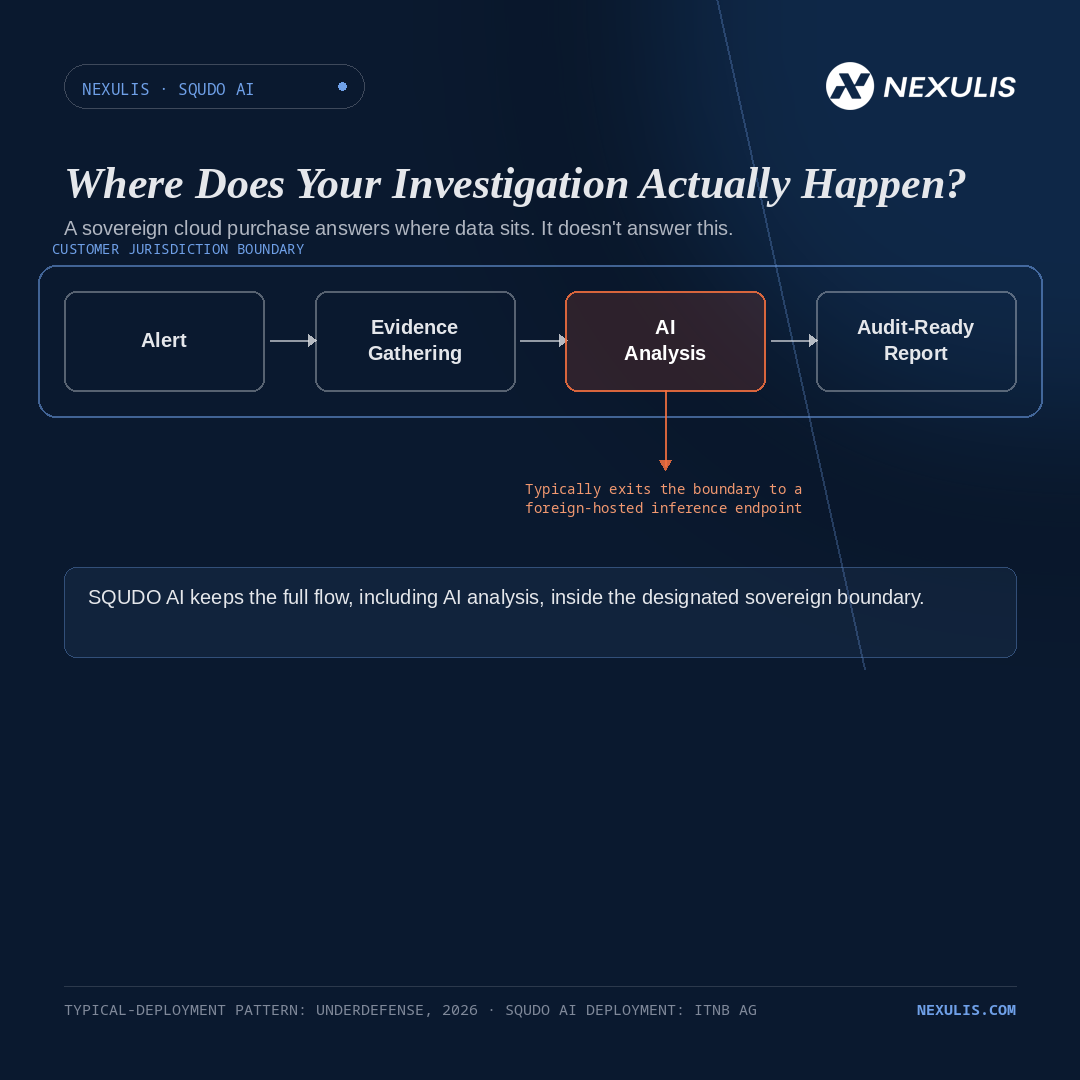
Where does your investigation actually happen
Most AI SOC tooling runs its analysis plane on US-hosted infrastructure, and the residency of that specific layer is rarely disclosed and almost never written into a contract. UnderDefense's buyer guidance exists precisely because the answer is usually unavailable: ask in writing which region the model reads your data in, and where the embeddings persist, before a single log flows. Most regulated buyers in this region are making that decision for the first time right now, with sovereign-cloud spending growing 35.6% globally and APAC governments treating sovereign AI as a strategic priority.
SQUDO AI®, an Agentic AI SOC Platform developed by ITNB AG and deployed in Southeast Asia through Nexulis, has no single default residency. Two deployment paths answer the boundary question directly. On-premises, on the customer's own infrastructure, the investigation layer, including the AI-analysis hop that typically exits the boundary in a conventional AI SOC deployment, never leaves the customer's own environment. Under the managed sovereign-SaaS model, data is processed and stored in the region the customer selects at provisioning (Singapore, Malaysia, Indonesia, or Switzerland), per the Trust Center's residency policy: no cross-region replication without explicit consent. Malaysian data can stay in Malaysia under either model; which one applies is a deployment choice made at setup, not a fixed default.
Worth being precise about what that means for a Malaysian buyer. The claim isn't that SQUDO AI defaults to Malaysian residency, it's that Malaysian residency is available, selected at provisioning and CBPDT/TIA-compatible, alongside on-prem and other regional options. A sovereign cloud purchase still doesn't automatically guarantee sovereign AI analysis: the buyer has to confirm which deployment model and which region apply, the same question this piece has argued every AI SOC vendor should be asked. What changes here is that SQUDO AI's answer to that question includes Malaysia as a selectable option, not just Switzerland.
A sovereign cloud purchase answers where data sits. It doesn't automatically answer where an investigation actually happens, which jurisdiction reads the evidence, or what leaves the boundary during triage. Those are the questions this piece has tried to make askable. The full argument, including the counter-case for infra-first sequencing, runs through each of the four provider questions above; the SQUDO AI product page covers how the investigation layer specifically stays inside the boundary.